
Kaufman County Bench Warrants Explained
A bench warrant is court process tied to a missed duty or court order, not the same thing as a new probable-cause arrest warrant. In Kaufman County, triggers can include a missed plea or appearance in a JP or city traffic case, an unpaid final fine that leads to capias pro fine, a missed county or district setting, contempt, or a bond-condition issue. The exact label and remedy depend on the issuing court.
Family or child-support matters belong with the district or family court, not a JP traffic clerk. A surety's Article 17.19 request is another path and is not the same as an ordinary failure to appear. Ask which court issued the process before choosing a payment, appearance, or motion route.
Kaufman County Capias Pro Fine Is Different
Local sources use “warrant of arrest,” “capias,” and “capias pro fine” for different process. A capias pro fine follows an unpaid final fine or judgment. A bench warrant usually responds to a missed appearance or other court default. A criminal arrest warrant rests on probable cause. The same person can have separate process in more than one court.
- Bench warrant
- Court process after a missed setting, order, or similar default.
- Capias
- A Texas writ directing custody after a court event or bond issue.
- Capias pro fine
- Process used to enforce an unpaid final fine or judgment.
How Kaufman County Bench Warrants Are Issued
The judge of the court handling the case decides what process follows a missed duty. A JP or municipal case stays with that lower court's clerk and may use a local citation or case portal. A district or county matter follows its court file and coordinator. The sheriff or another peace officer may serve process, but the issuing court controls the case status and recall.
There is no public statewide Texas warrant roster to fill the gap. OmniBase is a citation-compliance program tied to license renewal, not a warrant database. A blank county or custody search does not establish that the court has withdrawn a warrant.
Kaufman County JP Warrants Follow Precincts
For traffic and fine-only process, identify the JP court printed on the citation. JP1 serves the Kaufman area, JP2 the Forney area, JP3 the Terrell area, and JP4 the Kemp, Crandall, and Mabank area. Each office has its own case and payment route. JP1 warns about its *1 suffix; JP3 uses a case number ending in 3.
JP1's public payment and recall notice appears on its official court page.
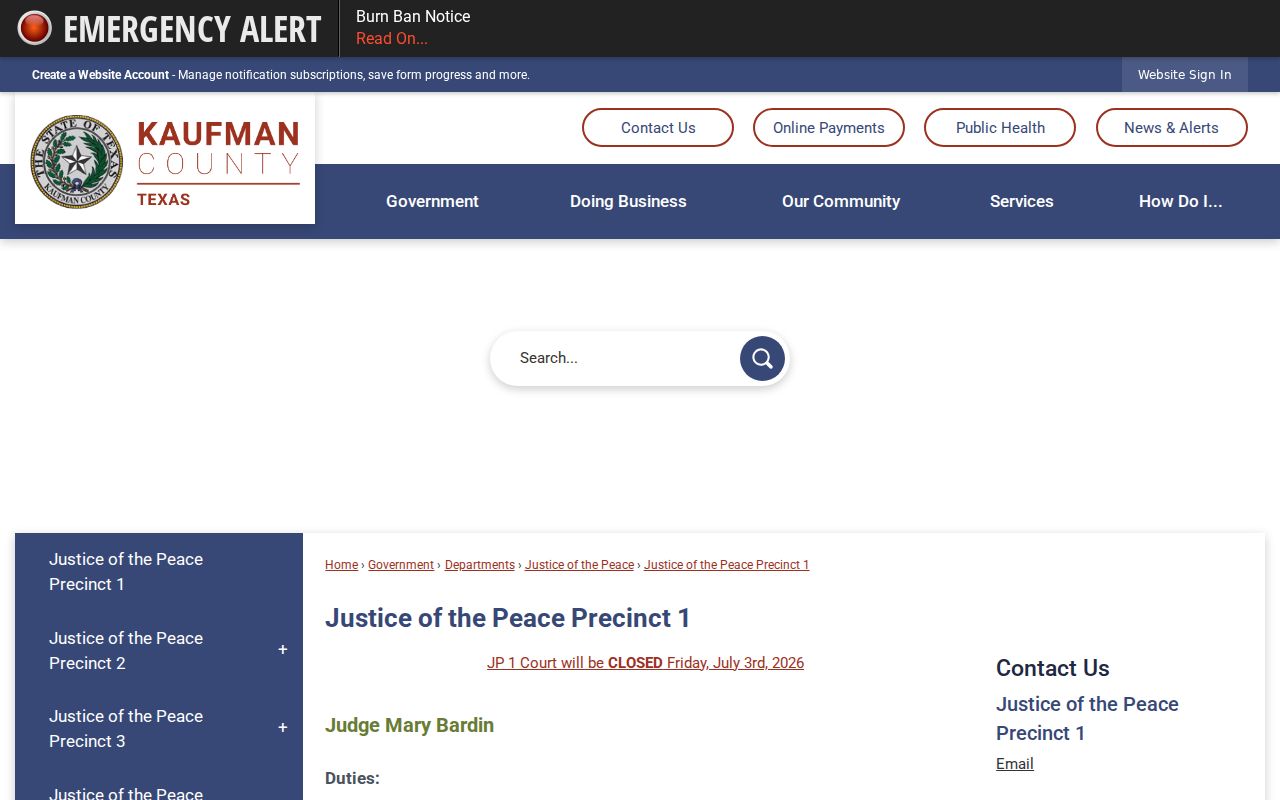
A court-specific suffix and notice can help route the question, but the clerk confirms whether a warrant is recalled.
JP2's case and payment instructions are separate at its court page.
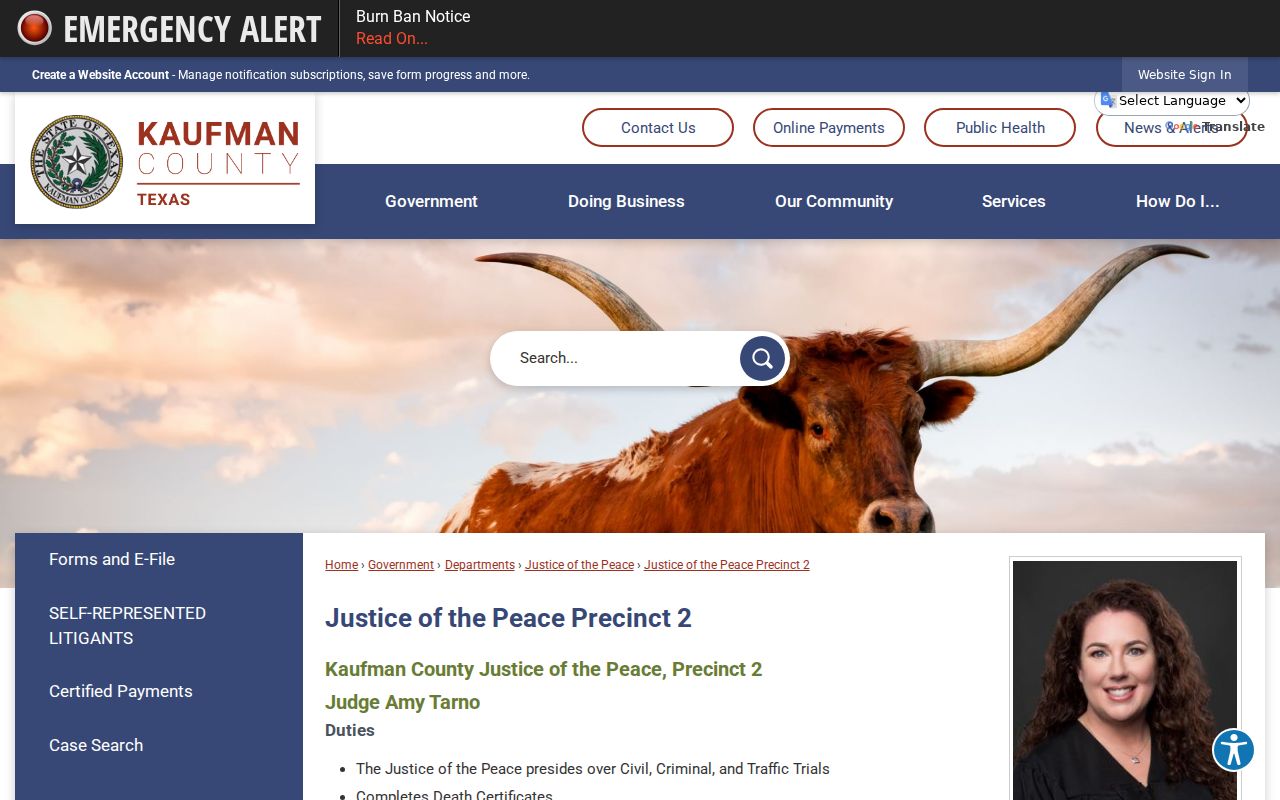
Confirm eligibility and the correct precinct before paying.
Bench Warrants and Arrest Warrants Compared
A bench warrant responds to conduct in an existing court case, such as missing a required setting. An arrest warrant generally authorizes custody based on a judge or magistrate's probable-cause review of an alleged offense. The court record, issuing authority, and next step therefore differ. Kaufman County has municipal, JP, county, and district dockets, so the same label may not tell you which clerk or judge must act. See the Kaufman County arrest warrant page for that separate process.
| Feature | Bench Warrant | Arrest Warrant |
|---|---|---|
| Trigger | Missed setting, violation of an order, or a court default | Judicial finding of probable cause for an offense |
| Who Issues It | The judge handling the existing case | A judge or magistrate reviewing an application |
| Underlying Case | An existing case with an unmet obligation | A criminal allegation or charge |
| How It Clears | Ask the issuing court about recall, setting, or compliance | Follow counsel's advice on bond, surrender, or court action |
Resolving a Kaufman County Bench Warrant
Use the court that issued the warrant, not a countywide search result, as the source for the remedy. Ask whether the court requires a motion, a new setting, proof of payment, or an in-person appearance. For a criminal matter or any uncertainty about arrest, counsel can contact the court and advise on a motion to recall or quash, voluntary appearance, or bond. Do not assume a payment portal will clear process immediately.
- Locate the cause, citation, or case number and confirm the issuing court and current status.
- Ask the clerk what action the judge requires and whether a payment, motion, or appearance is appropriate.
- For a criminal case, consult an attorney about a recall request, court appearance, and possible bond before taking action.
- Complete the court's instructions, then request confirmation that the warrant and any related hold were updated.
Caution: Do not ignore process or rely on an old search result; a court must confirm whether its warrant remains active and what will clear it.
Finding the Court That Issued the Warrant
Start with the citation, bond paperwork, notice, or docket entry. City ordinance and many Class C matters point to a municipal court; a justice-court citation identifies its precinct; felony and family matters belong in county or district-level files. The sheriff can explain custody or service information, but it cannot decide whether another court recalls its process.
If the issuing court is unclear, search the known case number through the appropriate clerk or use the Kaufman County warrant lookup steps to route the record. A person's name alone may produce no reliable match, especially where city and county systems are separate.
A 2025 Bail Review Order Changes One Route
Kaufman County's December 17, 2025 bail review order describes a summons-first process for the specified review matters. It does not create a universal rule that every missed hearing produces no warrant, and it does not replace the order in an individual case. Read the actual order and ask the assigned court whether it applies to the charge and stage of the case before relying on it.
The order is especially relevant when a person is trying to understand whether a missed review date should be handled as a new arrest process, a summons, or a setting in the existing case. The clerk can identify the docket; counsel can interpret how the order applies to an individual's circumstances.
Forney and Terrell Courts Have Local Payment Paths
Forney Municipal Court publishes information about indigency and alternative compliance for eligible defendants. Terrell Municipal Court provides a payment-plan route. Those options concern their own municipal dockets; they do not automatically apply to a Kaufman JP citation or a district-court case, and neither statement by itself confirms that a warrant has been recalled.
Check the city court named on the citation and ask what paperwork or hearing is needed. When an ability-to-pay issue is involved, raise it with that court before using a payment link or assuming that the balance is the only remaining issue.
Forney's official city court information and Terrell's official city court information are starting points; verify the current case procedure directly with the court.
District Cases Need the Case Coordinator
For district-court process, use the cause number and contact the court or coordinator associated with that docket. Kaufman County lists court coordinators separately from the District Clerk, and the coordinator may explain the judge's calendar or filing route while the clerk maintains the case record. A website search result cannot substitute for the court's decision to recall or reset a matter.
Keep a copy of any motion, order, receipt, or notice and ask whether the court requires a signed order before law enforcement systems update. That final confirmation matters when the original obligation, a bond condition, and a warrant entry are maintained in different places.
The 86th District Court page shows the court's coordinator and case-routing information.
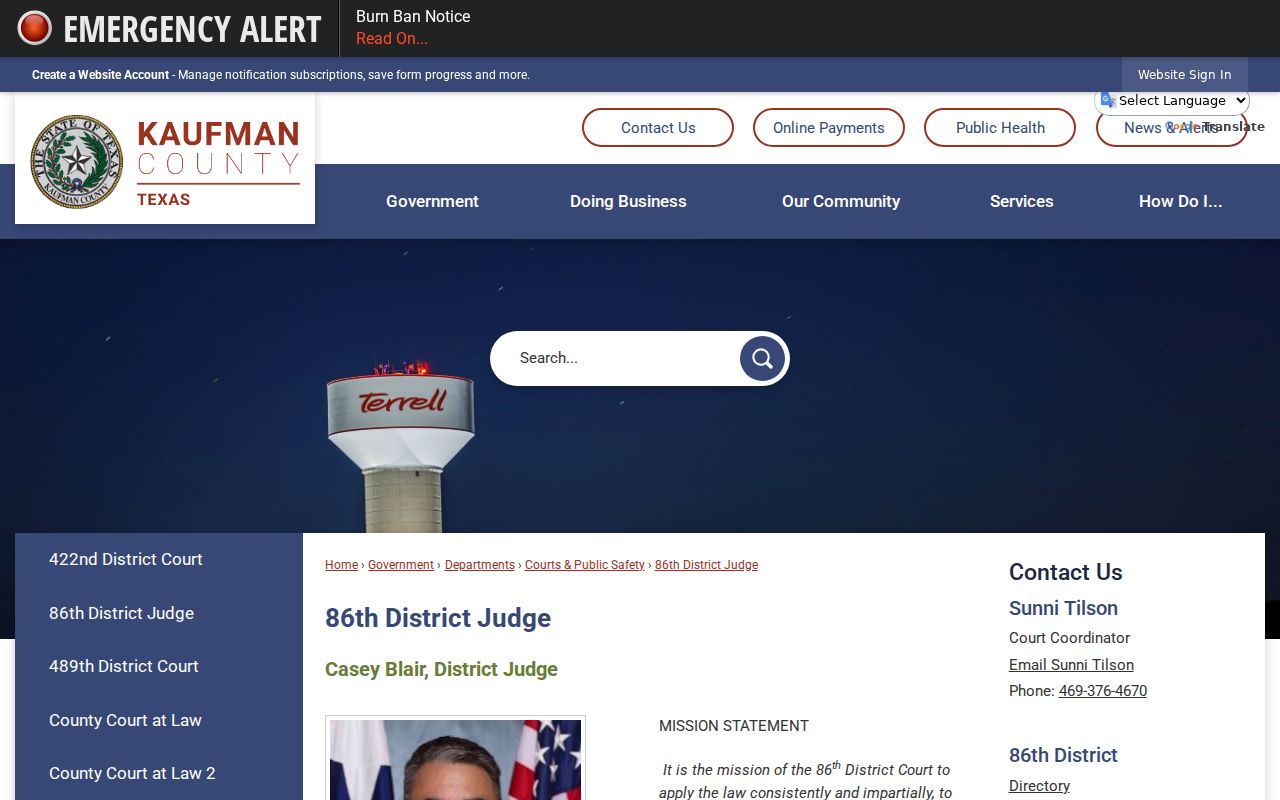
Use this contact to route a district case, then confirm warrant status with the assigned court.